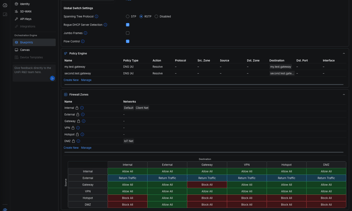
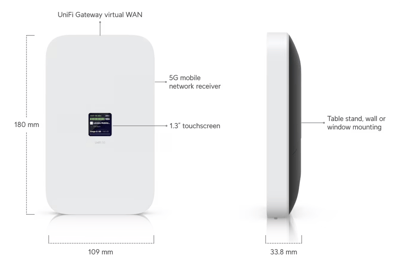
 The UniFi 5G Max is the long-awaited 5G extender/router. Ubiquiti is positioning it as a powerful 5G modem for any UniFi installation, which is plugged into any UniFi switch via PoE and automatically registers as an additional WAN line in the network application.
This closes a gap: locations can now be connected sensibly with fiber optics (FTTH) and 5G in parallel - with enough bandwidth and low latency to provide stable coverage even for larger offices with well over 100 employees.
What the UniFi 5G Max has to offer technically
A quick look at the key data:
-
5G modem with downlink in the gigabit range (Ubiquiti speaks of up to 2 Gbit/s with very good coverage).
-
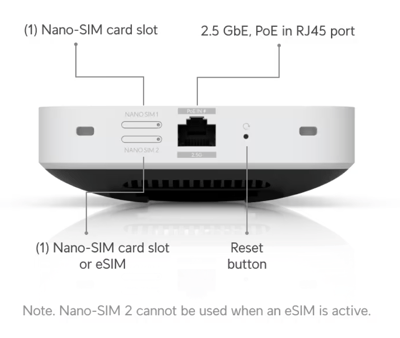
RJ45 port with 2.5 GbE - enough reserves to bring 5G performance to the LAN.
-
PoE supply: Power comes directly from the UniFi switch, no separate power supply unit required.
-
Two nano SIM slots plus eSIM support with dual SIM single standby - one SIM can serve as a backup if the other network fails.
-
Functions as a primary line, load-balancing WAN or classic failover WAN - controlled via the familiar UniFi routing policies.
In short: The 5G Max behaves like an additional ISP connection, only via mobile radio - fully integrated into the UniFi ecosystem.
What the UniFi 5G Max has to offer technically
A quick look at the key data:
-
5G modem with downlink in the gigabit range (Ubiquiti speaks of up to 2 Gbit/s with very good coverage).
-
RJ45 port with 2.5 GbE - enough reserves to bring 5G performance to the LAN.
-
PoE supply: Power comes directly from the UniFi switch, no separate power supply unit required.
-
Two nano SIM slots plus eSIM support with dual SIM single standby - one SIM can serve as a backup if the other network fails.
-
Functions as a primary line, load-balancing WAN or classic failover WAN - controlled via the familiar UniFi routing policies.
In short: The 5G Max behaves like an additional ISP connection, only via mobile radio - fully integrated into the UniFi ecosystem.
FTTH + 5G: Redundancy without the MPLS price tag
The classic setup for many companies:
-
An FTTH line as the main access to the Internet
-
In addition, possibly an old, expensive MPLS leased line for site coupling and SLA-guaranteed availability
With the UniFi 5G Max, a different model becomes attractive:
-
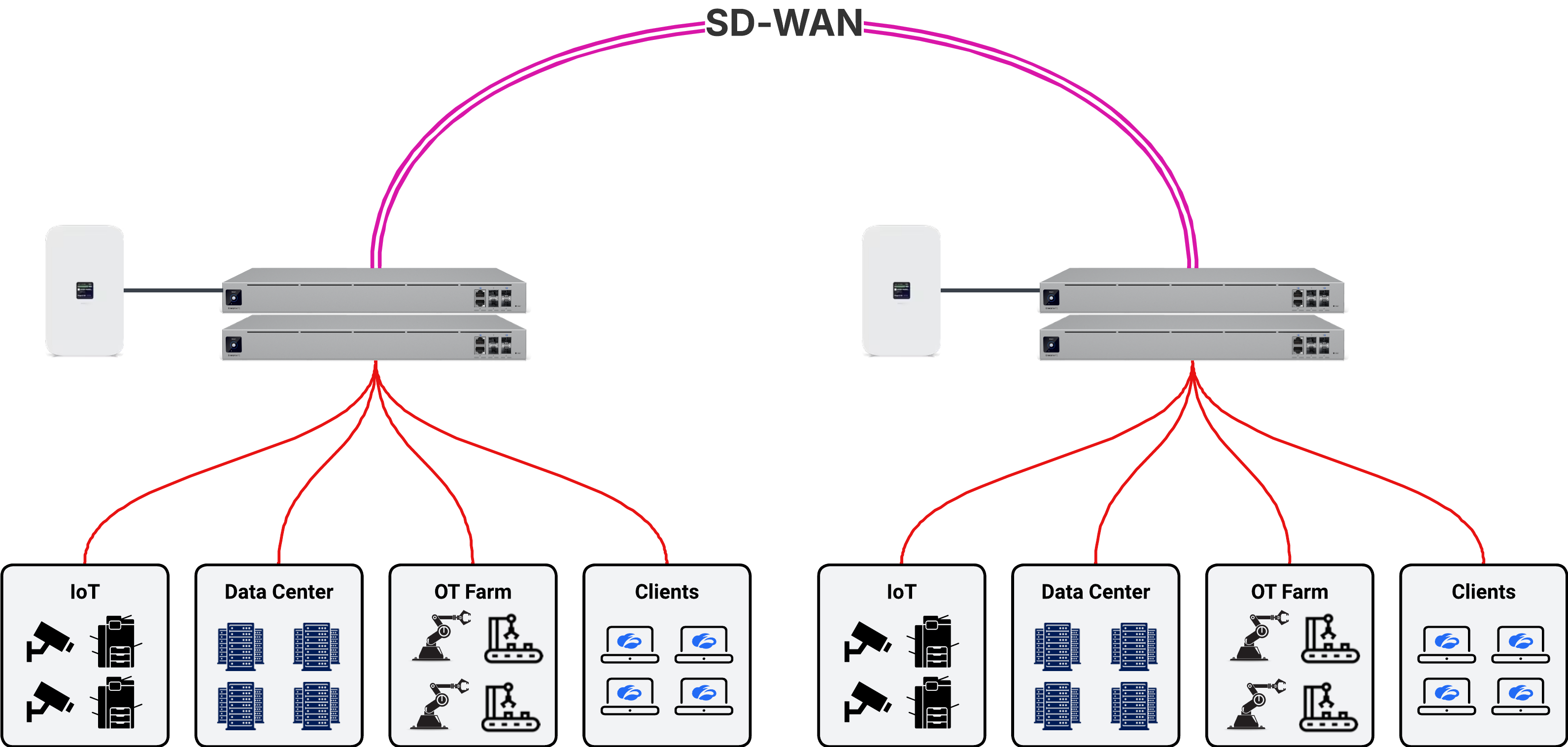
FTTH as the primary line, 5G Max as a second WAN uplink on the same UniFi gateway.
-
Encrypted site-to-site VPNs run between the locations via the public Internet access points.
-
If fiber fails or is damaged locally, the gateway automatically switches to 5G - the VPN connections remain in place and services can still be accessed.
Thanks to gigabit downlink and low latency on modern 5G networks, this approach is now also suitable for larger locations with many simultaneous sessions, video meetings and cloud workloads.
The result: a highly available WAN design with two independent access paths (fixed network + wireless), but without MPLS costs and without proprietary SD-WAN boxes.
Use case 1: Smooth transition away from MPLS
Many companies want to replace MPLS, but shy away from the "big bang". The 5G Max enables a gradual transition:
-
First, FTTH + 5G is put into operation in parallel with the existing MPLS.
-
Site-to-site VPNs are set up and traffic is gradually shifted from MPLS to Internet + 5G.
-
If everything is stable, MPLS can be scaled back or terminated completely.
Advantages:
-
Cost reduction: Instead of expensive MPLS routes, inexpensive Internet connections plus 5G are used as a reserve route.
-
More bandwidth: Fiber optics and 5G usually deliver significantly more throughput than old MPLS links.
-
Flexibility: New locations are connected via FTTH and/or 5G, without lengthy MPLS provisioning.
Use case 2: Locations without fiber optics - 5G as primary access
Not every company location has FTTH immediately. For new buildings, temporary offices, construction sites, warehouses or rural branches, 5G is often the fastest way into the network.
This is where the UniFi 5G Max comes into its own:
-
Primary line via 5G, optionally with dual SIM redundancy via two mobile network providers.
-
Later, a fiber optic or business cable line can be added and integrated into UniFi as an additional route via multi-WAN.
-
The device can be positioned flexibly via PoE (e.g. at a window or on an upper floor) to get the best reception.
In this way, locations can be made productive quickly without having to wait for civil engineering or provider appointments - and still with an integrated migration strategy as soon as FTTH is available.
Use case 3: Business continuity for cloud workloads
In many networks, central business processes are directly linked to SaaS services and public cloud workloads. A prolonged network outage means an immediate production stop.
With UniFi 5G Max, clear failover scenarios can be defined:
-
Critical VLANs (e.g. ERP, VoIP, IT remote access) are allowed to automatically switch to 5G in the event of a fault.
-
Less important services (e.g. social media, streaming) are throttled or completely blocked during failover to save data volume.
-
Policy-based routing and SLAs in UniFi are used to determine exactly when and for what 5G is used.
This means that 5G is not simply "just a second line", but a specifically controlled component of a business continuity plan.
Conclusion: 5G finally becomes a fully-fledged WAN component with UniFi
The UniFi 5G Max is more than just another 5G router:
-
It seamlessly integrates into the UniFi platform as a WAN interface, including PoE supply and centralized management.
-
With dual SIM/eSIM, 2.5 GbE port and Gigabit downlink, the hardware is clearly designed for professional scenarios.
-
In combination with FTTH and UniFi gateways, a network design is created that can economically replace MPLS and still offer high availability and performance.
For companies that already rely on UniFi, the 5G Max is the logical next step: redundancy, more bandwidth and true WAN flexibility - all from a single system.