UniFi Network Application 10.0.156 – New Version with great improvements
Version 10.0.123 of the UniFi Network Application primarily delivers consolidating changes with a clear focus: more automation, better usability, cleaner interfaces. For enterprise environments, this is more relevant than big show features because it strengthens standards, processes and scalability.
What's new about the API - and why it's strategically important
The official Network API has been expanded. Unadopted devices can now be listed via API and adopted directly. Firewall zones and ACLs can be created and managed; VLAN information can be called up, with full management to follow. There are also auxiliary endpoints (country list, DPI applications, WANs) as well as improved filters and clearer error messages.
For companies, this is the most important point of the release: with a more mature API, infrastructure automation becomes practicable. Configurations become reproducible, versionable and can be rolled out via CI/CD. This reduces manual work, lowers error rates and accelerates rollouts - across locations and clients. In short: a further step towards Infrastructure as Code for the campus, edge and WAN environment.
Firewall, zones and IPv6 - consistent policies with less effort
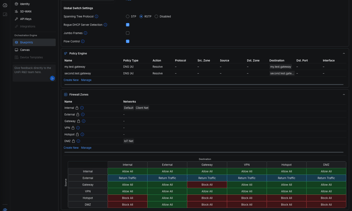
The zone-based firewall can now be managed via API, as can ACLs. In addition, the IPv6 interface identifier is supported for zone-based rules. This facilitates consistent security policies across many segments and locations. In practice, this means fewer special cases, clearer segmentation and easier scalability - especially in networks with many VLANs and mixed application zones.
User interface and visibility - small changes, noticeable benefits
Several detailed improvements are aimed at faster navigation and better analysis:
-
Port Manager now displays port statistics directly
-
Policy tables now have remove and pause actions
-
Topology, dashboard graphs and port views have finer filters
-
Vendor and device type filters make narrowing down easier
-
Page panels remember their state and open automatically when revisited
-
Activity logging settings are hidden when controlled by the control plane
-
The old legacy web UI has been removed
These steps sound unspectacular, but reduce friction in everyday life: fewer clicks, faster troubleshooting, fewer context switches - especially in larger environments with many devices.
Quality, validation and bug fixes - stable operation
Improved validations (e.g. for QoS policies) and clearer error returns from the API help to detect misconfigurations at an early stage. A bug has been fixed where VPN client disconnect events were missing in rare cases. These are typical reliability issues that count during operation: cleaner logging, more consistent telemetry, more resilient changes.
Context: what does this mean in concrete terms for companies
1) Automation as standard
With the extended API, recurring tasks - provisioning, adoption, policy rollouts, firmware maintenance - can be automated. This enables versioning, peer review and testability of network changes. Result: fewer human errors, faster changes, better compliance.
2) Governance and security across locations
Zones, ACLs and uniform objects form the basis for consistent policies in multi-site setups. This facilitates audits, reduces policy drift and simplifies onboarding of new sites.
3) Operational efficiency
The UI improvements save time in analysis, inventory and troubleshooting. Together with more stable validation, the effort required in day-to-day business is reduced - particularly relevant for teams with a high change throughput.
Compatibility, limits and next steps
-
VLAN management via API has been announced but has not yet been fully implemented; it is worth building processes now so that they can be seamlessly expanded later.
-
When migrating existing rulesets to zone-based models, a clean policy design is advisable (including tests on a staging system).
-
Removing the legacy UI may require adjustments to very old processes; in the medium term, this will pay off in the form of a more consistent stack.
Why we welcome 10.0.123
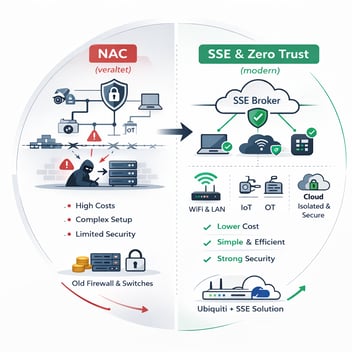
We have long relied on Ubiquiti in the WAN edge area because it allows us to build highly cost-efficient multi-vendor SASE environments - for example in combination with SSE components from Zscaler or Cloudflare. The expansion of the official API increases the utility value of these architectures: centrally orchestrated networks, reproducible policies, faster rollouts and lower operating costs.
Conclusion
10.0.123 is not a release for headlines, but for stable processes. The extended interfaces and UI fine-tuning are exactly the kind of progress that counts in corporate networks: less manual work, more consistency, better scaling. If you take automation seriously, you get building blocks that translate directly into efficiency and operational reliability.